
Thonburi Yannawa


Wat Arun Temple of Dawn
Originally known as Wat Bang Makok, it gained royal importance when King Taksin established Thonburi as the capital in 1767 after the fall of Ayutthaya, and the temple briefly housed the highly revered Emerald Buddha before the image was transferred across the river to the Grand Palace during the reign of King Rama I. The central prang of Wat Arun reflects the influence of Indian cosmology and Hindu-Buddhist concepts of Mount Meru, the sacred cosmic mountain described in Indian religious traditions as the axis of the universe. In Thai Buddhist cosmology, inherited largely through India-derived Sanskrit and Pali traditions, Mount Meru represents the center of the three worlds and the dwelling place of celestial beings. The towering central prang symbolizes Mount Meru, while the surrounding smaller prangs represent the cosmic mountain ranges and heavenly realms surrounding it. This reflects the deep integration of Indian cosmological ideas into Thai royal and religious architecture, where Hindu-Brahmanical concepts were adapted into a Buddhist worldview. Figures of devas (celestial beings), yakshas (guardian spirits), and mythological creatures reflect a shared religious vocabulary originating from Indian mythology, which entered Thailand through ancient kingdoms such as Funan, Dvaravati, Khmer-influenced Lavo, and later Sukhothai and Ayutthaya.
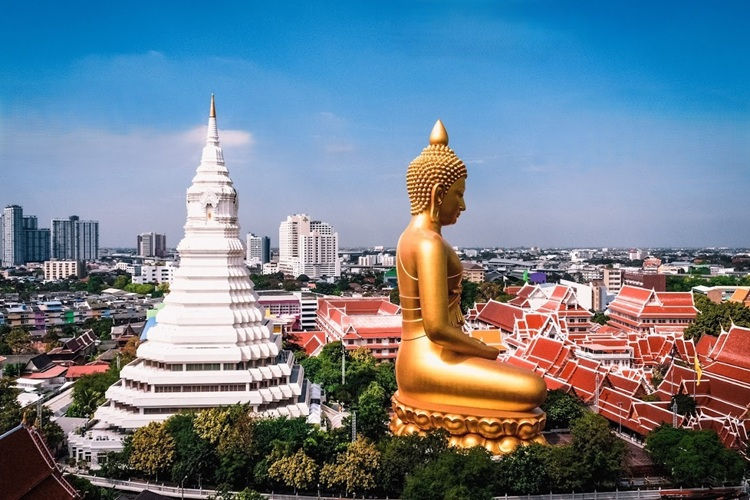
Wat Paknam Phasicharoen Giant Golden Buddha
Founded during the Ayutthaya period in the 17th century, the temple became an important center of Theravada Buddhist education, meditation practice, and monastic development. Its name, meaning “Temple at the Mouth of the Canal,” reflects its historic location within Bangkok’s extensive network of waterways, which served as major routes for commerce, migration, and cultural exchange. The temple’s emphasis on deep meditation practice connects with the ancient Indian contemplative traditions that existed before and during the time of the Buddha, while also preserving the Theravada interpretation transmitted through Sri Lanka and Southeast Asia. The Dhammakaya meditation approach emphasizes inner purification and the discovery of the “Dhamma body” (Dhammakaya), a concept drawing upon Buddhist metaphysical traditions preserved in Pali literature.
The temple’s most prominent landmark, is Bangkok's largest Buddha image at almost 70-meters tall. Beside is the white Phra Maha Chedi Maharatchamongkhon, a multi-tiered design follows the ancient Indian and Southeast Asian concept of the stupa as a representation of the Buddhist universe, symbolizing the path from the earthly realm toward spiritual awakening. The stupa form itself originated in ancient India as a sacred monument associated with the Buddha’s relics and became one of the most important architectural expressions of Buddhism across Asia. Within the chedi are meditation halls, sacred relic displays, and artistic representations of Buddhist cosmology, continuing a tradition that connects Thai temples with the wider Buddhist world of India, Sri Lanka, Myanmar, and Cambodia.
Klong Bang Luang Floating Market
Centered around the historic Baan Silapin (Artist’s House), the area features wooden stilt houses, small family-run shops, and local snacks sold along a quiet canal where boats still pass by. Visitors can experience cultural performances such as traditional Thai puppet shows, browse handmade crafts, and observe a way of life that reflects the city’s pre-modern riverine heritage. Khlong Bang Luang retains an authentic, community-based atmosphere shaped by art, history, and everyday local living.
Maha Mariamman Temple
Built in 1879 by Tamil immigrants, this Bangkok’s most prominent Hindu temple. The entrance features a 6-meter-high gopura (tower) richly decorated with intricate carvings of various Hindu deities in diverse shapes and sizes. The temple’s main shrine, crowned with a gilded copper-plated dome, is dedicated to Goddess Mariamman, a South Indian deity. Within the complex are two additional shrines dedicated to Ganesh and Kartikeya, which devotees visit in a set order: Ganesh, Kartik, then Mariamman. The temple hall is adorned with bronze statues of many Hindu gods including Shiva, Krishna, Vishnu, Lakshmi, Kali, Saraswati, and Nataraja with Shivakami, among others. There are also smaller shrines devoted to deities like Shiva Lingam, Brahma, Navagraha, Aiyanar, Saptha Kanni, Periyachi, Madurai Veeran, and Kathavarayan, reflecting the temple's religious significance.
Vishnu Temple
Completed in 1920, the Vishnu Temple in Bangkok’s Yannawa district was established by the local Hindu community, particularly migrants from Uttar Pradesh, India. Built in a northern Indian architectural style, the temple features intricate marble statues imported from Jaipur and is primarily dedicated to Lord Vishnu (Narayana). The temple houses around 24 Hindu deities, including Brahma, Shiva, Ganesh, Hanuman, Sita and Rama, Krishna, Lakshmi, Parvati, Saraswati, and even Lord Buddha, each revered by worshippers.
Asiatique The Riverfront
Set along the riverside in a revitalized industrial-style complex, this destination blends heritage architecture with modern retail and dining experiences. Converted from old warehouses, the space retains its rustic charm with exposed brickwork and open layouts, creating a unique atmosphere for leisurely exploration. Visitors can browse boutique shops, enjoy a variety of eateries, and take in scenic views of the river, especially during the evening when the area comes alive with ambient lighting.
Originating from the renowned Jurassic Park film franchise, the Jurassic World immersive attraction brings prehistoric creatures to life through realistic animatronics and themed environments. Visitors can walk through jungle-like settings, encounter life-sized dinosaurs, and engage with interactive exhibits that combine education and entertainment.