
attire
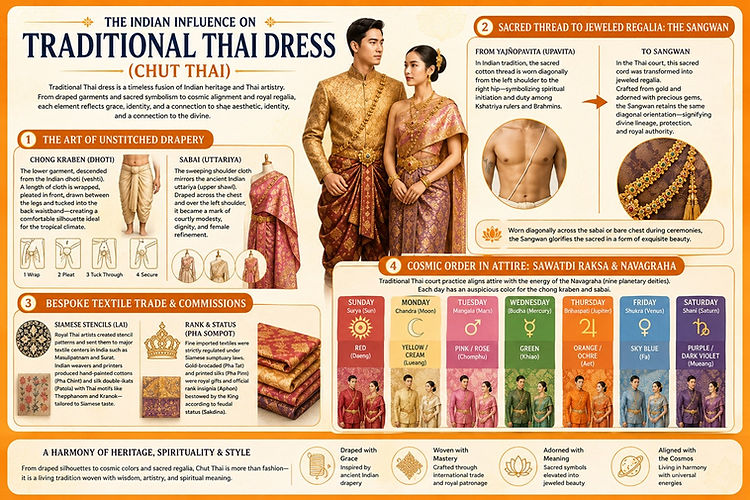
Traditional Thai dress (Chut Thai) represents one of Southeast Asia's most sophisticated syntheses of foreign cultural influence and native artistry. Rooted in ancient Indian concepts of drapery, sacred symbolism, and cosmic alignment, Siamese fashion transformed classical Indian textile traditions into a distinct visual identity defined by shimmering brocades and meticulous craftsmanship.
The Art of Unstitched Drapery
Long before modern tailoring arrived in the region, early Thai attire relied on the ancient Indian philosophy of the unstitched draped garment. The Siamese court commissioned Indian textile workshops to produce luxurious fabrics decorated with uniquely Thai designs, and these royal textiles were then bestowed by the King as symbols of rank, office, and noble status
The Chong Kraben (Dhoti): Worn across all social strata by both men and women, the lower garment known as the chong kraben descends directly from the Indian dhoti (or veshti). Wrapped around the waist, it was gathered and pleated at the front, then drawn between the legs and tucked into the rear waistband.
The Sabai (Uttariya): The sabai—the graceful shoulder cloth draped diagonally across the chest and over one shoulder—evolved from the Indian uttariya, an ancient upper-body shawl. In the Thai court, wearing a sabai over the torso or a fitted inner garment became an important expression of modesty, dignity, and feminine refinement. Unlike the Indian sari, which combines a lower wrap with a shoulder drape into a single garment, the sabai remained a distinct, separate cloth paired with the chong kraben
Bespoke Siamese Stencils (Lai): During the Ayutthaya and early Rattanakosin periods, the Siamese court (Krom Tha / Department of Eastern Maritime Affairs) dispatched stencil patterns created by royal Thai artists to major textile centers in India, such as Masulipatnam (Coromandel Coast) and Surat (Gujarat). Indian master weavers and printers produced hand-painted, mordant-dyed cottons (Pha Chint or Chintz) and silk double-ikats (Patola) featuring distinctly Thai motifs, such as Thepphanom (praying celestial beings) and Kranok (flame-like vines), specifically tailored to Siamese aesthetic preferences.
Rank and Status (Pha Sompot): Fine imported Indian textiles were strictly regulated under Siamese sumptuary laws. High-grade gold-brocaded cloths (Pha Tat) and fine printed silks (Pha Pim) served as official rank insignia (Aphon), gifted directly by the King to governors, ministers, and military commanders according to their feudal status (Sakdina).
Sacred Threads to Jeweled Regalia: The Sangwan
In classical Hindu tradition, the Yajnopavita (or Upavita) is a sacred cotton thread worn diagonally across the torso - from the left shoulder down to the right hip, symbolizing spiritual initiation and royal duty among Kshatriya rulers and Brahmins. In the Thai court, this spiritual cord was reinterpreted into haute couture regalia known as the Sangwan.
Rather than simple cotton, Thai court goldsmiths crafted multi-tiered, articulated chains of pure gold studded with rubies, emeralds, and diamonds. Worn diagonally across the sabai or on a bare chest during formal ceremonies, the Sangwan retains the exact structural orientation of the Indian sacred thread while serving as a glittering physical signifier of divine lineage and royal authority.
Cosmic Order in Attire: Sawatdi Raksa & Navagraha
The traditional Thai court practice of wearing specific colored garments for each day of the week originates directly from Indian Vedic astrology (Navagraha—the nine planetary deities).
Codified in literary texts such as Sunthorn Phu’s 19th-century court etiquette manual, Sawatdi Raksa, royalty and court attendants carefully coordinated the colors of their chong kraben and diagonal sabai to align with the cosmic energy of the deity ruling that day:
Sunday (Surya / Sun): Red (Daeng)
Monday (Chandra / Moon): Yellow or Cream (Lueang)
Tuesday (Mangala / Mars): Pink or Rose (Chomphu)
Wednesday (Budha / Mercury): Green (Khiao)
Thursday (Brihaspati / Jupiter): Orange or Ochre (Aet)
Friday (Shukra / Venus): Sky Blue (Fa)
Saturday (Shani / Saturn): Purple or Dark Violet (Mueang)