
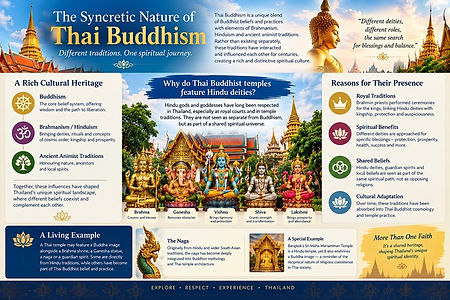
Syncretic Beliefs
Thai Buddhism is frequently described not as a single, isolated doctrinal system, but as a dynamic syncretic matrix. While Theravada Buddhism serves as the overarching institutional authority and ethical foundation, religious life in Thailand often incorporates other distinct traditions: including local animism and Hinduism.
Thai Buddhism is deeply syncretic, meaning that Buddhist beliefs and practices have developed alongside—and often incorporated—elements of Brahmanism, Hinduism and older animist traditions. Rather than existing as completely separate religious systems, these traditions have interacted in Thailand for many centuries. The Thailand Foundation describes Thai spiritual culture as a complex blend of Buddhism, Brahmanism-Hinduism and traditional animistic beliefs.
This helps explain why visitors may encounter Hindu deities inside or around Buddhist temples. Gods such as Brahma, Shiva, Vishnu, Ganesha, Indra, Lakshmi, Saraswati and Parvati are respected by many Thai Buddhists and may be worshipped alongside Buddha images and local guardian spirits.
Historically, Hindu-Brahmanical traditions reached mainland Southeast Asia through long-standing cultural connections with India. Brahmin traditions became particularly influential at royal courts, where Brahmin priests performed ceremonies connected with kingship, auspiciousness and the protection of the kingdom. These traditions continued alongside Buddhism rather than being completely replaced by it. The royal Brahmin tradition in Bangkok, for example, includes shrines to Shiva, Ganesha and Vishnu and remains an important part of Thailand's ceremonial heritage.
There is also a practical religious dimension. In popular Thai spirituality, different sacred beings may be approached for different forms of assistance. Buddha is revered as the teacher who shows the path to liberation, while Hindu deities and local spirits may be approached for blessings relating to protection, prosperity, success, health or particular aspects of worldly life. This does not necessarily mean that Thai Buddhists regard themselves as converting from one religion to another. Rather, different layers of religious belief can coexist within the same person's spiritual life.
This is why a Thai Buddhist temple might contain a Brahma shrine, a Ganesha image, a naga, a guardian spirit or other Hindu-influenced imagery alongside the principal Buddha image. Some are directly connected with Hindu traditions; others have been absorbed into Thai Buddhist cosmology and popular religious practice. The naga, for example, has Hindu and wider South Asian origins but became deeply integrated into Buddhist mythology and Thai temple architecture.