
Old Bangkok


Royal Grand Palace & Emerald Buddha Temple
The Grand Palace and its sacred core, Wat Phra Kaew, together form the spiritual and political heart of old Siam, established in 1782 by King Rama I at the founding of Bangkok. The temple enshrines the revered Emerald Buddha, a supremely important image of the Buddha carved from green stone, symbolizing the legitimacy and divine protection. Architecturally, the complex layout reflects the cosmological concept of Mount Meru, the sacred center of the earth in Hindu and Buddhist cosmology.
Hindu elements are especially visible in the temple’s iconography and decorative program. The gallery walls are adorned with murals depicting the Ramakien, Thailand’s localized version of the Indian epic Ramayana, illustrating scenes of Rama, Hanuman, and Ravana in vivid Thai style. Mythical guardians such as yakshas (giant demons) stand at the gates, reflecting Hindu cosmological beings adapted into Thai Buddhist symbolism. Together, the Grand Palace and Wat Phra Kaew are not only masterpieces of Thai architecture, but also living embodiments of the deep cultural exchange between India and Southeast Asia, where Hindu cosmology and Buddhist devotion merge seamlessly into the Thai royal tradition.
Queen Sirikit Museum of Textiles
Established by Queen Sirikit to preserve and promote Thailand’s rich textile heritage, the museum highlights how Her Majesty revitalized rural weaving communities by elevating Thai silk into globally recognized haute couture. Exhibits showcase intricate weaving techniques, natural dyes, and ceremonial costumes, many inspired by ancient court traditions that subtly reflect Indian influences such as brocade patterns, gold-thread weaving, and motifs linked to Hindu cosmology and royal symbolism.
Wat Pho (Reclining Buddha)
Architecturally and artistically, Wat Pho reflects strong Indian influence through its cosmological layout, stupas (chedis) inspired by ancient Indian reliquary forms, and mural depictions of the Ramakien, which itself derives from the Indian epic Ramayana. One of the most remarkable features of Wat Phra Chetuphon Wimon Mangkhalaram (Wat Pho) is its extensive collection of stone inscriptions on traditional medicine, commissioned during the reign of King Rama III in the 19th century. These inscriptions were intended to serve as a public repository of knowledge, effectively transforming the temple into Thailand’s first open university. It is also the birthplace of traditional Thai massage, preserved today through the renowned Wat Pho Thai Traditional Medical School. These elements illustrate how Indian religious philosophy, Ayurvedic healing traditions, and epic literature were adapted into a distinctly Thai cultural and spiritual framework.
Sala Chalermkrung Khon Show
Showcasing Thailand’s classical masked dance, this performance brings the Ramakien epic (Thailand's version of Ramayana) to life through graceful movements, elaborate costumes, and traditional music. The theatre setting enhances the immersive experience, allowing audiences to appreciate one of the country’s most refined art forms. It serves as a cultural highlight for those interested in Thai performing arts.
Wat Arun Temple of Dawn
The central prang of Wat Arun reflects the influence of Indian cosmology and Hindu-Buddhist concepts of Mount Meru, the sacred cosmic mountain described in Indian religious traditions as the axis of the universe. In Thai Buddhist cosmology, inherited largely through India-derived Sanskrit and Pali traditions, Mount Meru represents the center of the three worlds and the dwelling place of celestial beings. The towering central prang symbolizes Mount Meru, while the surrounding smaller prangs represent the cosmic mountain ranges and heavenly realms surrounding it. This reflects the deep integration of Indian cosmological ideas into Thai royal and religious architecture, where Hindu-Brahmanical concepts were adapted into a Buddhist worldview. Figures of devas (celestial beings), yakshas (guardian spirits), and mythological creatures reflect a shared religious vocabulary originating from Indian mythology, which entered Thailand through ancient kingdoms such as Funan, Dvaravati, Khmer-influenced Lavo, and later Sukhothai and Ayutthaya.
Wat Paknam Phasicharoen Giant Golden Buddha
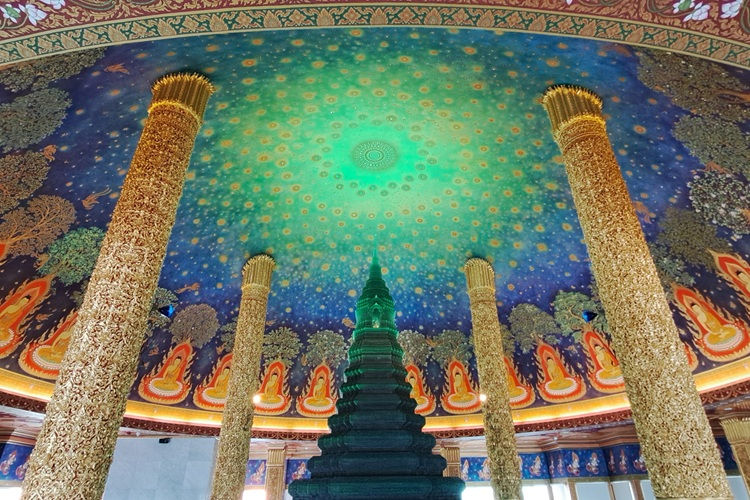
The temple’s emphasis on deep meditation practice connects with the ancient Indian contemplative traditions that existed before and during the time of the Buddha, while also preserving the Theravada interpretation transmitted through Sri Lanka and Southeast Asia. The temple’s most prominent landmark, is Bangkok's largest Buddha image at almost 70-meters tall. Beside is the white Phra Maha Chedi Maharatchamongkhon, a multi-tiered design follows the ancient Indian and Southeast Asian concept of the stupa as a representation of the Buddhist universe, symbolizing the path from the earthly realm toward spiritual awakening. The stupa form itself originated in ancient India as a sacred monument associated with the Buddha’s relics and became one of the most important architectural expressions of Buddhism across Asia. Within the chedi are meditation halls, sacred relic displays, and artistic representations of Buddhist cosmology, continuing a tradition that connects Thai temples with the wider Buddhist world of India, Sri Lanka, Myanmar, and Cambodia.